
Can I qualify for life insurance using just my phone camera?
Can you qualify for life insurance using just your phone camera? Here is how camera-based screening fits into accelerated underwriting and who it may help.
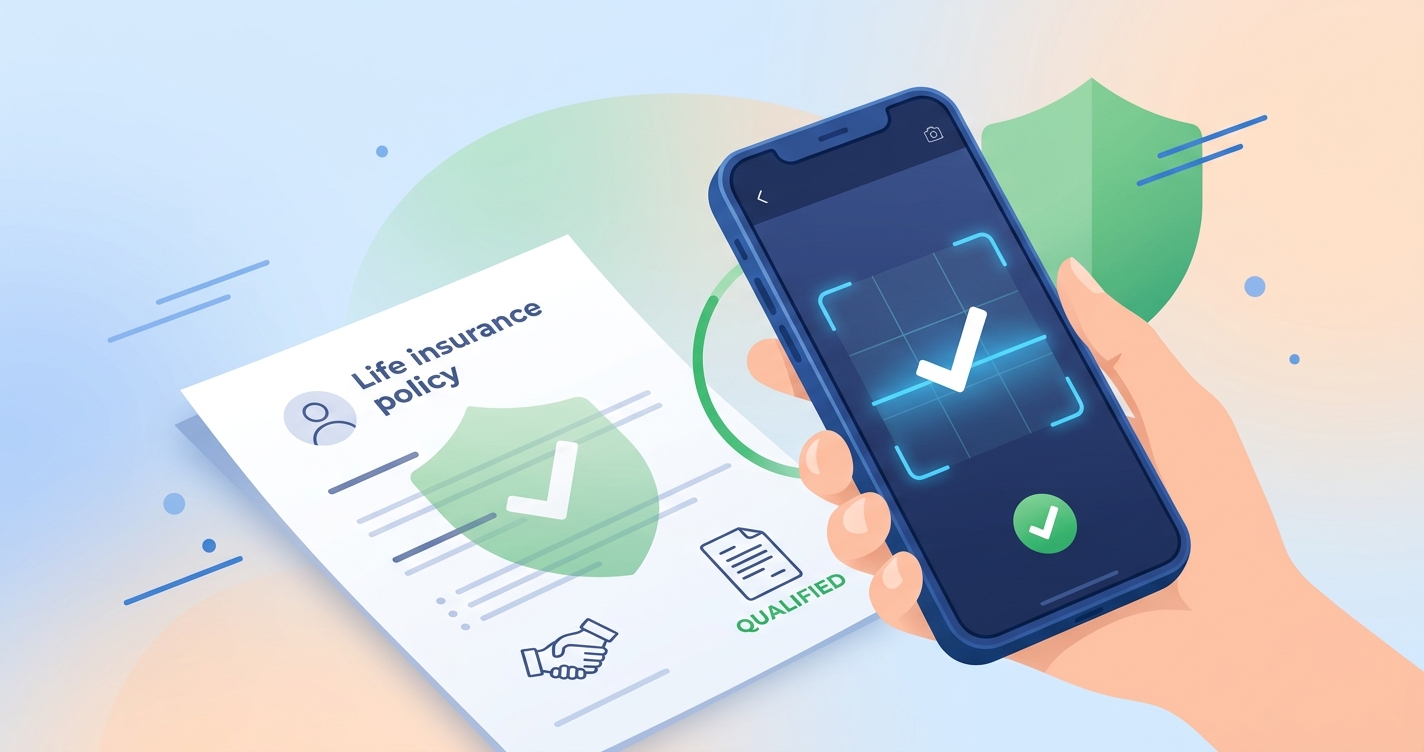
Can I qualify for life insurance using just my phone camera?
In some cases, yes. But the honest answer is narrower than the marketing headlines make it sound. A phone-camera scan can be part of a life insurance application, especially inside accelerated underwriting programs, yet it usually works as one evidence source inside a broader decision flow rather than as a magical replacement for every other requirement.
"An average 59% of individual life insurance applications now qualify for an accelerated underwriting path." — Gen Re, 2025 U.S. Individual Life Next Gen Underwriting Survey
For applicants, that means the real question is not whether a camera alone can approve everyone. The real question is whether your age, coverage amount, disclosed health history, prescription profile, and insurer rules place you in a segment where a short digital health check can replace a nurse visit or lab work.
How phone-camera qualification works in life insurance
If you are asking whether you can qualify for life insurance using just my phone camera, you are really asking how far accelerated underwriting has moved away from traditional evidence collection.
In a classic underwriting process, carriers might order a paramed exam, blood draw, urine sample, APS records, prescription checks, and manual review. In a newer digital flow, the carrier may still look at data sources in the background, but it can decide that a shorter, lower-friction application path is enough for some applicants. That is where phone-camera screening enters the picture.
The technology most people are talking about is remote photoplethysmography, or rPPG. In the foundational 2008 Optics Express paper on remote plethysmographic imaging, Wim Verkruysse, Lars O. Svaasand, and J. Stuart Nelson showed that ambient light and an ordinary digital camera could capture pulse-related signals from the face. Since then, insurers and underwriting vendors have been exploring whether those signals can support faster risk assessment in consumer application flows.
That does not mean the insurer points your selfie camera at your face and instantly knows everything about your health. It means the camera can contribute digital biometric evidence that may help a carrier decide whether a full exam is necessary.
What a phone-camera path can and cannot replace
The easiest way to think about it is to compare four common application paths.
| Application path | What the applicant does | Evidence the insurer may use | Best fit | Main limitation |
|---|---|---|---|---|
| Fully underwritten | Full application plus exam and fluids | Paramed exam, labs, records, Rx, MIB | Higher face amounts or complex histories | Slowest and most expensive path |
| Accelerated underwriting | Application plus database checks | Rx, MIB, MVR, credit-based or other third-party data | Lower-risk applicants | Not everyone qualifies |
| Digital health check | Application plus short phone-camera session | Camera-based biometrics plus background data | Applicants eligible for modern digital flows | Scan quality and rules still matter |
| Simplified issue | Short application with fewer requirements | Mostly disclosures and rules engines | Smaller policies, fast decisions | Coverage and pricing can be narrower |
The industry trend is real. Gen Re's 2025 survey says 59% of applications are now eligible for an accelerated path. LIMRA's 2024 Insurance Barometer study also found that consumers keep pushing the market toward faster, easier digital buying experiences, with 71% using some form of digital research before buying insurance. Carriers are responding to that demand because long, invasive workflows hurt completion rates.
Still, eligibility is selective. A carrier may invite one applicant into a camera-based flow and route another applicant to a nurse visit for reasons that have nothing to do with whether the technology exists.
Who is most likely to qualify
The applicants most likely to qualify for a phone-camera-first path usually share a few traits:
- They are applying for a coverage amount that fits the carrier's accelerated rules
- They fall within the program's target age band
- Their disclosed health history does not trigger immediate manual review
- Prescription, MIB, and other third-party checks do not raise major flags
- They can complete the scan in conditions the system accepts
That last point matters more than people expect. A camera-based health check is still a measurement workflow, not just a selfie.
Bhargav Acharya, William Saakyan, Barbara Hammer, and Hanna Drimalla at Bielefeld University reported in their CHILL study on remote photoplethysmography that performance can degrade under elevated heart rates and challenging conditions. In plain English: if the applicant is moving, poorly lit, or outside the conditions the model handles well, the scan may not be usable enough to support a decision.
So yes, you may qualify using a phone camera. But you also may be asked to retry, routed to another path, or asked for more evidence.
Why insurers are interested in the phone-camera model
The carrier incentive is not mysterious.
Traditional evidence collection adds cost, delays issue, and causes applicants to disappear. Every extra scheduling step creates abandonment risk. That is why accelerated underwriting has spread so quickly. According to Gen Re, the top goals in next-generation underwriting are reducing time to issue, managing mortality slippage, and increasing sales.
Phone-camera screening fits that logic because it can:
- Reduce the need for in-home paramed scheduling
- Keep the application inside one mobile session
- Give underwriting teams another digital evidence source
- Support faster straight-through or near-straight-through decisions
From the consumer side, the appeal is obvious too. Nobody is eager to book a nurse visit, wait for labs, and drag out a purchase decision for weeks if a shorter path is available.
Current research and evidence
The scientific base behind camera-based measurement is stronger than it was a decade ago, but it is still a field defined by careful qualification rather than blanket promises.
The original proof point remains the 2008 work by Verkruysse, Svaasand, and Nelson showing that facial video under ambient light can recover plethysmographic signals remotely. More recent reviews have focused on how to make that work outside the lab.
A review by Alora Brown, Joeri Tulkens, Maxime Mattelin, Tanguy Sanglet, and Brecht Dhuyvetters in Frontiers in Digital Health examined 96 studies related to remote photoplethysmography and adjacent technologies. Their conclusion was not that the problem is solved forever. It was that camera-based measurement has become broad enough and credible enough to support health-assessment use cases, while still requiring careful attention to robustness, signal quality, and deployment conditions.
The Bielefeld University CHILL work points in the same direction. The opportunity is real, but performance depends heavily on environment and physiology. That is exactly why insurers use digital biometrics inside rules-based workflows instead of pretending one quick scan answers every underwriting question.
Where phone-camera underwriting works best
The strongest near-term fit is not every policy for every person. It is lower-friction underwriting for applicants who are already close to qualifying through accelerated rules.
Term life with moderate face amounts
This is the most natural use case. The carrier wants speed, lower acquisition cost, and fewer abandoned applications.
Digital-first direct-to-consumer distribution
If the sale begins on a phone, the evidence collection step also needs to work on a phone. Otherwise the process breaks right where intent is highest.
Supplemental evidence in hybrid underwriting
Some carriers will not use camera-based signals as a standalone gate. They will use them as one more data layer next to disclosures, records, and prescription data.
Frequently asked questions
Does a phone-camera scan guarantee approval?
No. It may help you qualify for a faster underwriting path, but approval still depends on carrier rules, disclosed history, third-party data, and policy amount.
Why did someone else get approved by phone when I was sent to a nurse exam?
Because accelerated underwriting is segmented. Two applicants can apply to the same carrier and land in different evidence paths based on age, face amount, prescription history, and other underwriting triggers.
Is the insurer only looking at the camera scan?
Usually no. In most modern flows, the scan is one input among several, alongside application disclosures and background underwriting data sources.
Can poor lighting affect whether I qualify?
It can affect whether the scan is usable. Research on rPPG keeps showing that motion, lighting, and physiology influence signal quality, which is why carriers build retry logic and fallback paths into digital workflows.
If you are evaluating where the market is heading, the bigger story is not whether one selfie can replace underwriting. It is that underwriting is gradually shifting toward faster, lower-friction evidence collection. Solutions like Circadify are being built for that shift, giving insurers new ways to gather digital biometric evidence without defaulting to the old nurse-visit model every time. For more context, see our analysis of fluidless underwriting programs in 2026 and why life insurance still requires a blood draw in 2026.